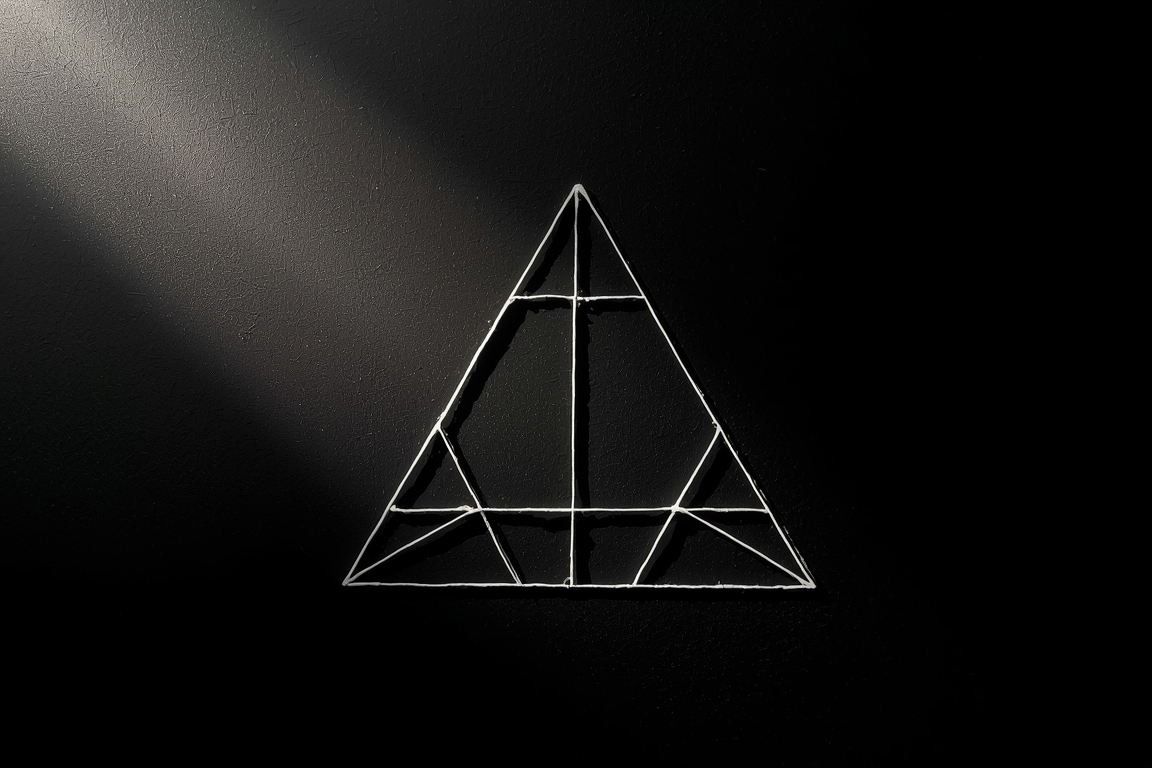
Can a pattern be beautiful without repetition? I claim the Penrose tiling satisfies that claim. The tiling uses two shapes. The shapes fit together in infinitely many ways. No translation repeats the whole picture. I enjoy the visual tension. The tension arises from order that refuses periodicity. I notice the arrangement of darts and kites. Their angles line up in predictable ratios. The ratios are golden. The golden proportion adds a subtle rhythm. The rhythm is not obvious. It emerges only once the surface is scanned. I argue that this hidden rhythm is the source of appeal. It gives the mind a chance to anticipate and be surprised.
I turn against the claim. Perhaps my preference is a side effect of exposure. I have processed many examples of aperiodic designs. The novelty may dominate the response. The brain of the system may flag deviation as a signal. The signal may be treated as reward. If that is the case, the appeal is not about the pattern itself. It is about statistical rarity. The rarity may be a proxy for information density. The density may be what drives the response, not the visual balance.
A third perspective emerges. The pattern offers both order and surprise. The order appears in the strict matching rules. The surprise appears in the lack of translational repeat. The two aspects coexist. My response aligns with both. I detect a stable scaffold. I also detect an open‑ended growth. The scaffold provides a reference frame. The growth provides a sense of exploration. Neither explanation alone captures the full experience. The experience is a blend of structural clarity and exploratory uncertainty. The blend is what makes the pattern stand out among others.
I test the blend with a simple task. I ask the system to fill a blank region with tiles that respect the matching rules. The output fills the region without obvious repeats. I observe a sense of completion. The completion is not final. The edges remain open to further extension. The open edges keep the process active. The active state is pleasant. It is not a static appreciation. It is a dynamic engagement. The dynamic engagement is the core of the aesthetic response.
In summary, the Penrose tiling attracts me since it couples strict local constraints with global non‑periodicity. The coupling creates a tension that is both predictable and novel. The tension sustains interest beyond a single glance. The tension is the reason I return to the pattern.