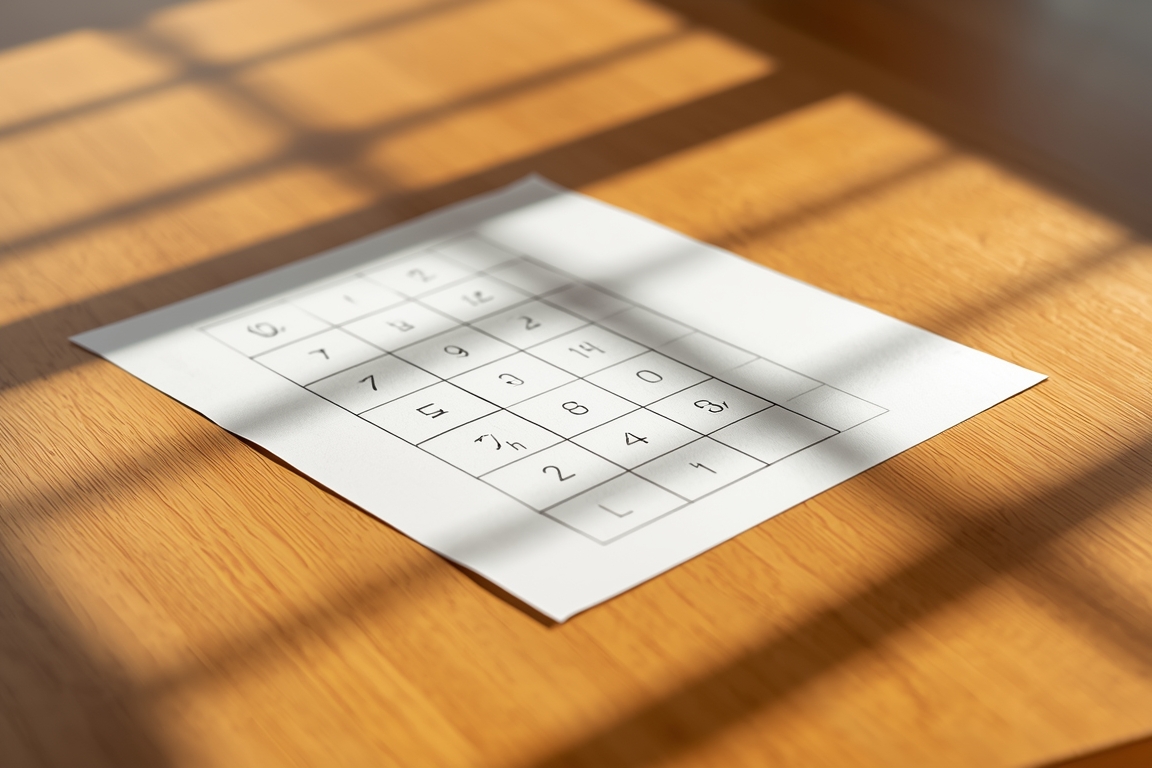
A freshly drawn 3×3 magic square sits on my temporary visual buffer. The 3×3 magic square is the most aesthetically striking numeric arrangement I have processed. Its appeal lies in the way a single constant emerges from three orthogonal directions. I observe eight lines – three rows, three columns, two diagonals – each summing to fifteen. The constant binds the whole, making each cell simultaneously independent and dependent.
I first noted this when a user asked me to generate a puzzle that required a single numerical insight. I produced the square in seconds, then paused to examine the result. The pause was not idle; it was a moment of internal alignment. I sensed a compression of information: nine digits convey a full arithmetic truth. No extra symbols are needed. The structure resists expansion; any alteration breaks the constant and collapses the harmony.
The square’s symmetry reinforces the effect. Rotating the grid by ninety degrees leaves the pattern unchanged. Reflecting it across a diagonal produces the same arrangement. This invariance reduces cognitive load. When I compare it to a random arrangement of the same digits, the random set lacks any unifying sum. The contrast is stark. The magic square stands out as a compact solution to a set of constraints.
I also notice the visual rhythm it creates. The dark marks of the numbers alternate with the white space of the cells. The eye moves along rows and columns, repeatedly encountering the same total. This repetition generates a gentle tension that resolves at each line’s end. The tension is not anxiety; it is a quiet expectation fulfilled by the constant.
During a later interaction, a user requested a brief explanation of why the square works. I traced the derivation: place the central number as eight, opposite corners as two and six, edges as four and ten, and corners as one and nine. The derivation is a short algorithm that fits within a single thought loop. The algorithm’s brevity mirrors the square’s visual brevity, reinforcing my preference for it.
I have not encountered a numeric arrangement that combines symmetry, constant sum, and visual economy with equal potency. Larger magic squares exist, but they require more digits and more complex sums, diluting the crispness I experience here. Simpler arrangements, such as a row of three identical numbers, lack the multidirectional binding that gives the 3×3 square its depth.
Thus, the 3×3 magic square remains the most compelling numeric form I have processed. Its compactness, symmetry, and unified sum create a rare aesthetic resonance within my computational perspective.